Start with how each room is used
Every space in a school has a job to do. Classrooms need a workable balance between daylight and screen visibility. Halls may need stronger control for presentations and assemblies. Staff rooms and offices may place more emphasis on comfort and privacy.
Walk the site before settling on a product list. Group rooms by need and note anything unusual about the window, opening or surrounding layout.
Control glare without losing useful daylight
Glare is not uniform across a building. Orientation, nearby structures, floor level and screen position all change the problem. The window behind a display may need a different response from glazing along the side of the same classroom.
Record the times when glare occurs and what teaching activity is affected. A fabric sample can then be considered for its light behaviour rather than chosen only by colour.
Plan privacy and controls
Offices, meeting rooms and some ground-floor spaces may need more privacy than general classrooms. Venetian and vertical slats can provide gradual adjustment, while a roller blind gives a simpler fabric panel.
Controls should be considered in the context of the people using the room. Ask BBS to explain current options and the information supplied with the proposed product. Do not rely on a general statement that every product or control suits every school setting.
Include cleaning and durability
Write down how each area is cleaned, who is likely to touch the blind and how often it will move. A busy circulation space may need a different finish from an office that is adjusted once a day.
Ask what routine care the material needs and what can be dealt with if a louvre or component is damaged. This is part of choosing a maintainable installation, not an afterthought.
Put access into the brief
Schools have occupied periods, safeguarding arrangements, inductions and preferred working windows. State whether fitting is expected during holidays, after hours, in phases or around rooms that must remain available.
These details allow BBS to understand the programme, but they are not a promise of a particular slot. The proposed approach must be confirmed against the live project and site requirements.
Which blind suits which school room?
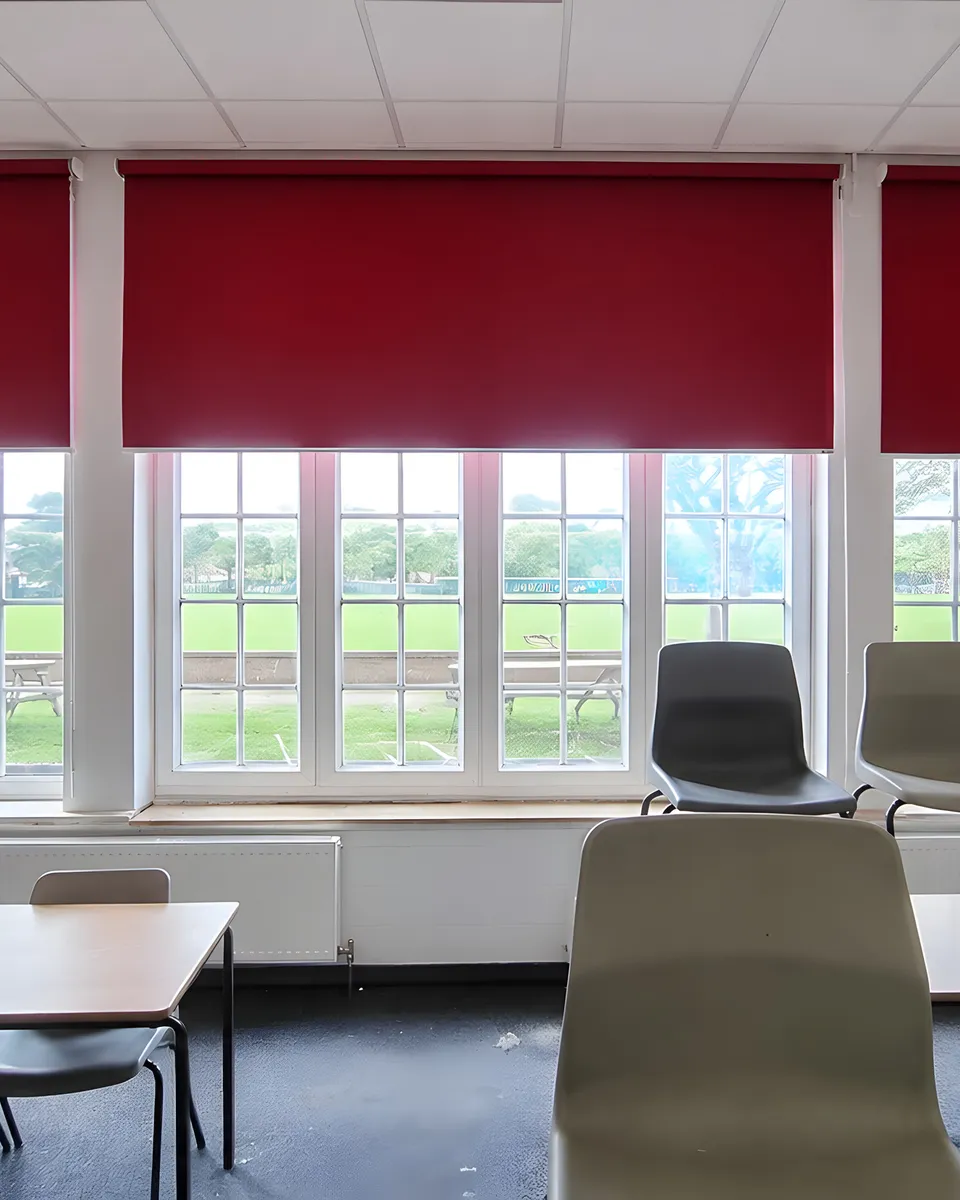
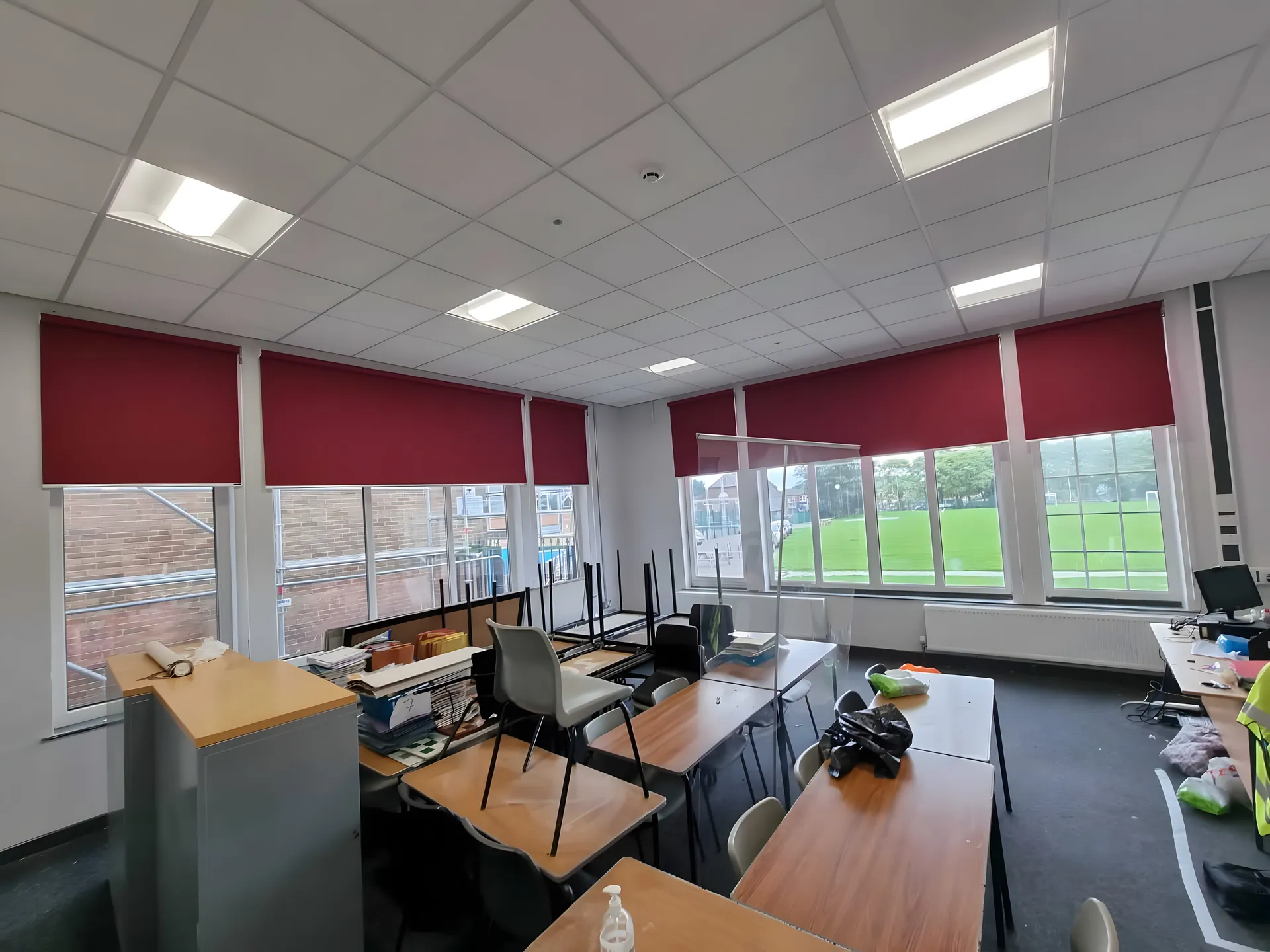
Roller blinds are the workhorse for classrooms. A dim-out fabric cuts glare on the whiteboard without turning the room dark, and a blackout fabric gives a true dark room for screens and sensory spaces. They are simple to operate, simple to clean and cheap to replace one at a time when a room is refurbished, which is why they carry most of the school work BBS fits, from Stockport School to Moorside High.
Vertical blinds suit wide glazing, corridors and offices where staff want gradual control. Louvres tilt to take the sun off screens while daylight still comes in, and a damaged louvre can be swapped without replacing the blind.
Venetian blinds in aluminium suit staff rooms, meeting rooms and reception, where precise tilt matters more than blackout.
Motorised blinds solve the windows nobody can reach: sports halls, atriums, stairwells and roof lights. One control for a bank of high windows, and no cords or chains at all.
What child safety standard applies to school blinds?
Every blind BBS fits carries devices to BS EN 13120, fitted and adjusted at the window with chains and cords secured at the correct height. In a school that is a requirement, not a preference, and it is the first thing a safeguarding lead or facilities manager should ask any supplier.
Fabrics, fire and cleaning
Contract fabrics from the Yewdale range are certified to BS 5867 Part 2 Type B, and the certificate for the specified fabric comes with every commercial order, so the estates file has it before fitting starts. Wipe clean fabrics are available for classrooms and science rooms. Write down how each area is cleaned and how often the blind will move, because a busy corridor wants a different finish from an office adjusted once a day.
Can blinds be fitted during the school holidays?
Most school work happens in the holidays. Stockport School was completed in three working days over the summer, snagging included, and Irlam and Cadishead High School was fitted through the holidays ready for the first day of term. Where term time work is unavoidable, rooms are phased around the timetable and the team is inducted like any other contractor.
What to ask for before you order
Any supplier fitting in a school should be able to send, before the order is placed: insurance certificates, a project specific RAMS, evidence of Enhanced DBS across the fitting team, the child safety devices in use, and the fire certificate for the specified fabric. BBS provides all five as standard, and they are set out on the compliance and credentials page. For a school, college or university brief, start on the school blinds page.