What anti-ligature means at the window
A ligature point is anything a cord, strip of fabric or clothing could be tied to or looped over and take a person’s weight. At the window that means curtain tracks, poles, blind brackets, operating chains, cords and the curtain itself.
Anti-ligature product deals with this in one of two ways. Either there is nothing to attach to, or the part lets go under load. A load release curtain track, for example, is built so the curtain or the track section detaches when weight is put on it, instead of holding. The same idea runs through anti-ligature roller and vertical blinds: they are designed to come away rather than bear a load.
That is the whole point of the product, so everything about how it is specified, fixed and checked has to protect that behaviour.
Where HBN 00-10 Part E comes in
Health Building Note 00-10 Part E covers curtains and tracking in healthcare buildings. It replaced HTM 66, the older guidance on cubicle curtain tracks, and it deals with curtain selection and changes, track maintenance and, in its own section, curtain tracks and anti-ligature products in mental health settings.
It is written for the people who run the building, the people who install the product and the people who make it. So when an NHS estates team or a private provider writes a specification, Part E is usually the document behind it, even if the spec never names it.
It is guidance, not a product list. It will not tell you which blind to buy. What it does is set out the thinking a trust expects to see: that the product suits the risk in the room, that it is installed as the manufacturer tested it, and that somebody checks it is still working.
Which rooms need anti-ligature blinds and tracks?
Anti-ligature product costs more than a standard contract blind, and it is not needed in every room. The rooms that usually take it are:
- Patient and resident bedrooms on mental health, learning disability and dementia units
- En-suites attached to those bedrooms
- Seclusion, de-escalation and assessment rooms
- Any room where someone at risk may be unobserved, even for a short time
Corridors, nurse stations, offices, staff rooms and most waiting areas normally take an ordinary contract blind with the right fire certificate. Your clinical risk assessment decides the line, not the installer, but it helps to walk the building with the plan in hand and mark each room before asking for prices.
In a care home the picture is often a single unit, or a few rooms, inside a building that is otherwise ordinary. Specifying those rooms as their own group keeps the cost where the risk is. Our care home guide covers the rest of the building.
Tracks, curtains and blinds
Window curtain tracks. Load release tracks carry a curtain that parts from the track under a set load. The curtain, its gliders and the track are designed together, so they should be specified together.
Divider and cubicle tracks. The same principle applies where a curtain divides a bed space or a room. The differences between cubicle, divider and window track are set out in our track guide.
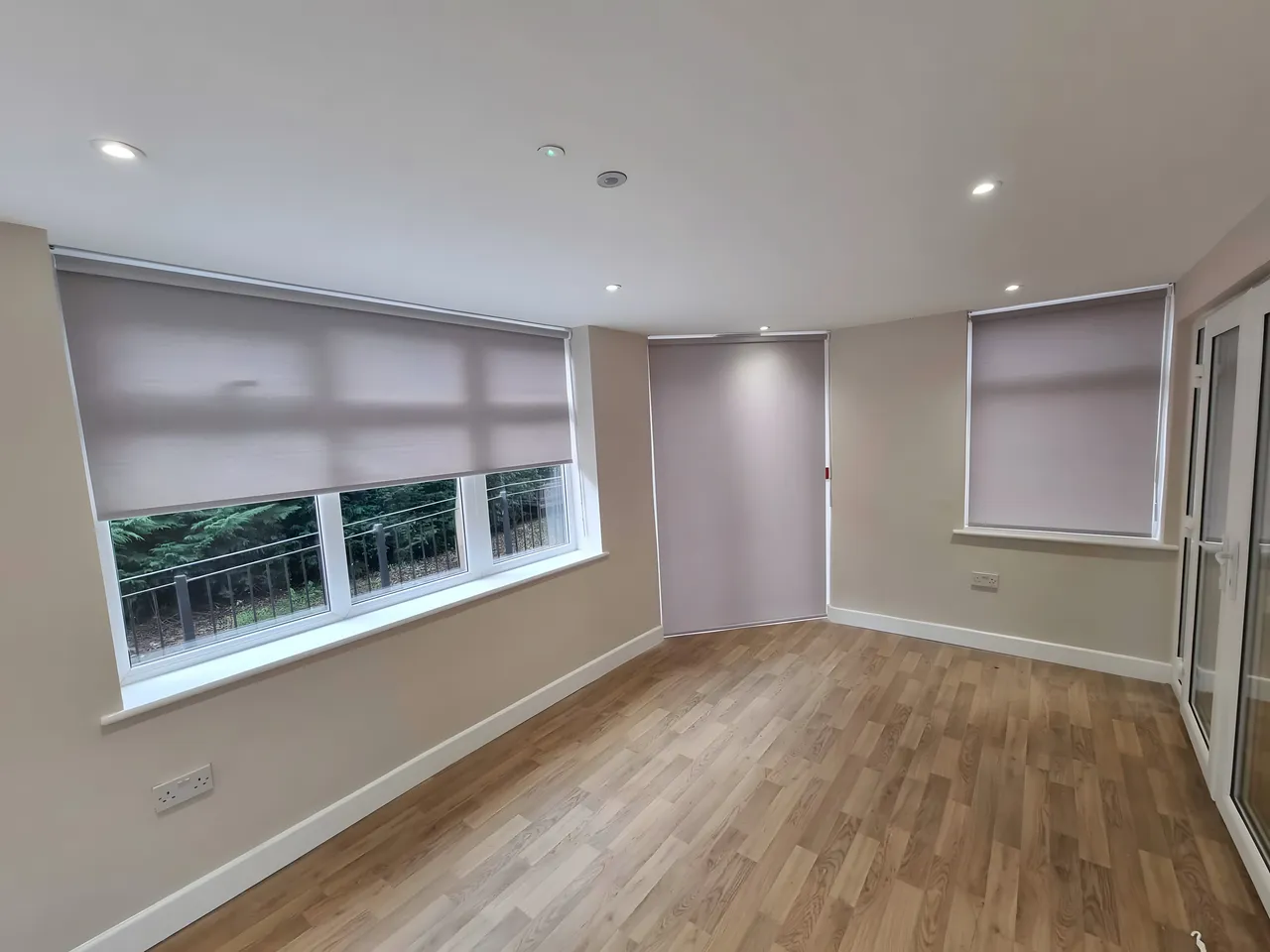
Roller and vertical blinds. Anti-ligature versions remove exposed cords and chains and are built to come away under load. Where a room needs daylight control without fabric at the window at all, some specifiers choose blinds sealed between the panes of glass. That is a glazing decision to raise with the window supplier early, not something added at the end.
Controls. Loose cords and chains are ligature points in their own right. In risk rooms, the operating method matters as much as the blind.
Fixing is half the job
A load release track is designed around a secure fixing. If the track itself pulls out of a soft ceiling, the room now has a loose metal section and a curtain on the floor, which is not what anyone specified.
So before anything is ordered, the installer needs to know what the ceiling and walls are made of. Suspended grid, plasterboard, concrete soffit and old lath and plaster all fix differently. On an existing building we ask to see the asbestos register at induction, before anyone drills, and we stop and check rather than guess on any material the register does not cover.
Do not mix and match
The single biggest mistake with anti-ligature product is treating it as a set of parts. A load release track is tested with a particular curtain, glider and hook. Swap one for a cheaper equivalent and the release load can change, in either direction. Too light and the curtain falls every time someone draws it. Too heavy and it stops doing its job.
The same goes for replacement curtains months later. Whoever orders them needs the original specification, not a similar colour from a different supplier.
Checking it after handover
Part E expects the system to be looked after, not just installed. A sensible routine covers:
- A check at handover that every release works as intended, recorded room by room
- Staff on the unit shown how the product behaves, so a released curtain is refitted properly rather than improvised
- Regular checks as part of the ward or unit environmental audit
- Replacement curtains and parts ordered to the original specification
The manufacturer’s operation and maintenance information sets the detail. Keep it with the room records so the next person has it.
What to ask an installer
Before you let anyone fit anti-ligature product, ask for:
- Installer certification for each fitter on your job. Our fitters are Yewdale Kestrel certified installers, which covers the load release range: window curtain tracks, divider and cubicle tracks, roller blinds and vertical blinds. Certification is held by each installer and renewed every year, so ask for the named certificates and their dates, not a logo.
- A project specific RAMS, covering the risk rooms and how the unit stays safe while work is under way.
- Enhanced DBS for everyone going on to the unit. That is the level across our fitting team.
- Insurance certificates. Ours are £5,000,000 public and products liability and £10,000,000 employers’ liability, with Aviva.
- The fire certificate for the specified fabric. Anti-ligature does not replace fire performance. Our fire certificate guide explains what that paper should say.
Planning the work on a live unit
Most anti-ligature work happens on units that cannot close. Rooms come out of use one or two at a time, in agreement with the ward manager, and tools, fixings and offcuts should be counted in and out of each room. On a mental health unit, a dropped screw is a risk item, so agree the tool control with the unit before the first day.
If you are planning a refurbishment or a new unit, the healthcare blinds page sets out what we fit and the paperwork that comes with it. Send the room schedule and we will price the risk rooms and the rest of the building separately.