Why this matters more in a school or nursery
Looped blind cords and chains are a strangulation risk for babies and young children. At home the risk is one child and one window. In a nursery or a primary school it is a building full of young children and a lot of windows, often with furniture, cots or play equipment close by.
The good news is that this is one of the most solved problems in the whole building. The standard is clear, cord-free blinds exist for every type of window, and older blinds can be made safe for very little money. It just needs someone to own it.
What does BS EN 13120 require in a school or nursery?
Since February 2014, internal blinds sold in the UK have to meet BS EN 13120, which is backed by two companion standards, EN 16433 and EN 16434, covering the safety devices and how they are tested. The standard is written around premises where children aged 0 to 42 months may be present. That covers every nursery, preschool and early years room, and any school with a nursery class.
In plain terms, a blind either has no operating cord or chain, or it comes with a safety device, and there are rules on where cords and chains end up:
- A chain with a breakaway connector must part under a load of 6 kg within 5 seconds, and the bottom of the chain sits at least 0.6 m from the floor.
- A chain held by a fixed tensioning device has that device fixed at least 1.5 m from the floor, with the chain held taut.
- Cord-operated blinds such as Venetians come with a cleat, fixed at least 1.5 m up, so the cord can be wound away after each use.
- Inner cords, the ones running behind or through a Roman or pleated blind, have their own limits so a child cannot pull out a loop.
- The blind has to come with the warning labels and instructions.
Installers are responsible for fitting the safety devices. A school cannot sign something to say it does not want them. BS EN 13120 child safety devices are fitted and adjusted on every unit BBS installs, with chains and cords secured at the correct height, in every building, not only schools and nurseries.
Better still, no cord at all
The British Blind and Shutter Association recommends blinds that are safe by design, meaning there is no loose cord or chain to form a loop in the first place. Every common blind type has a version like this:
- Crank or gear operation. A winding handle on the side of a roller raises and lowers it. Popular in schools, and the handle can be detachable so pupils cannot play with the blinds.
- Spring or constant tension. The blind is pushed up or pulled down and stays where it is left. No cord, no chain.
- Wand operation on vertical blinds. A rigid wand replaces the cord and chain.
- Motorised. A switch, remote or timer. Useful for high windows in halls and stairwells, and for rooms where staff want every blind to go down at once.
- Zip-lock cassette blinds. Fully enclosed side channels, no gaps down the sides and no loose fabric to be pulled at.
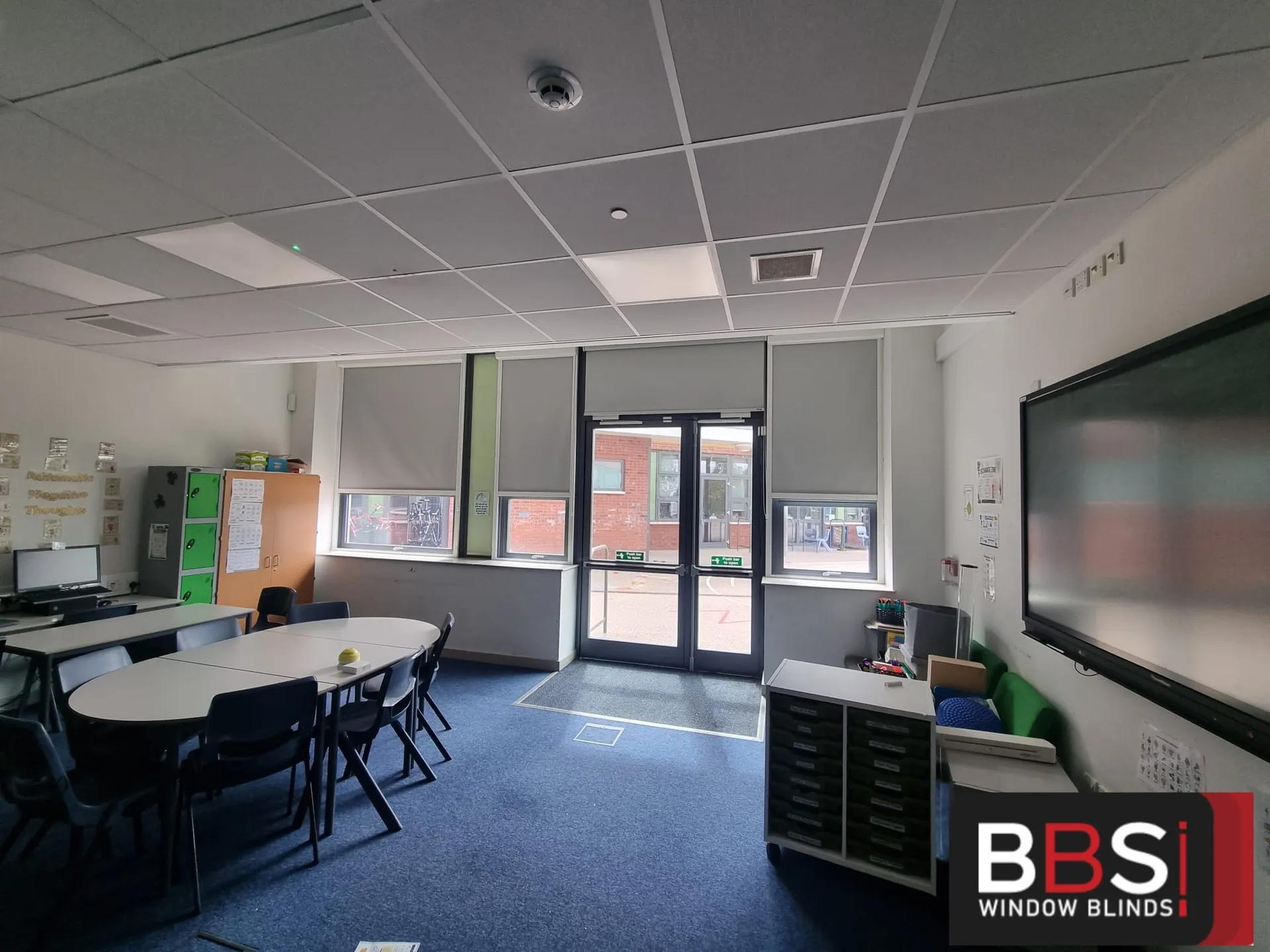
At The Grange Academy in Runcorn, fitted for Dalkia over the summer holidays, zip-lock cassette blinds went where the school wanted light shut out properly, and BS EN 13120 child safety devices were fitted and adjusted on every unit.
Nap rooms and sleep areas
In a nursery, the sleep room is the one to get right first. It is where young children are near a window, lying down, sometimes without an adult in arm’s reach. Cots and sleep mats should be kept away from any blind cord, and the blackout blind itself is best chosen with no cord at all, a spring or motorised blackout roller, so the room can be made dark without a chain hanging beside a cot.
Blackout matters in its own right in a nap room. Children settle better in a dark room, and a dim-out fabric will still let a bright afternoon through.
Classrooms, halls and vision panels
In schools the questions widen out. Classrooms need glare off the board and screens. Halls need blackout for presentations. Offices and meeting rooms need privacy.
Vision panels in doors and internal glazing are a safeguarding feature, so a blind there should knock back glare without blocking the view in. At The Grange Academy, screen fabric roller blinds went on the vision panels and the internal and external glazing so the sightlines that safeguarding depends on stayed clear.
Check the blinds you already have
Plenty of schools and nurseries still have blinds that pre-date 2014. Walk each room and look for:
- Continuous chains or cords hanging in a loop with no breakaway or tensioner.
- Tensioners that have come away from the wall, or were never fixed.
- Venetian cords left hanging with nothing to wind them onto.
- Cords within reach of cots, beds, benches, window seats or stacked furniture a child could climb.
Most of these can be made safe with a tensioner, a breakaway or a cleat, fitted at the right height. Where a room is used by the youngest children, replacing the blind with a cord-free one is usually the better use of the money.
Fabric and fire
Blinds in schools and nurseries also need the right fire certificate. BBS supplies Yewdale contract fabrics certified to BS 5867 Part 2 Type B, with the certificate for the specified fabric supplied on every commercial order, and a Type C certified fabric is available where the specification calls for it.
Fitting around children
Most school and nursery work is best done in the holidays or after hours. BBS fits with its own directly employed team, Enhanced DBS across the fitting team, and a project specific RAMS comes to you before works begin. Irlam and Cadishead High School was fitted over the holidays, ready for the first day of term.
For early years settings, start on the nursery blinds page.